
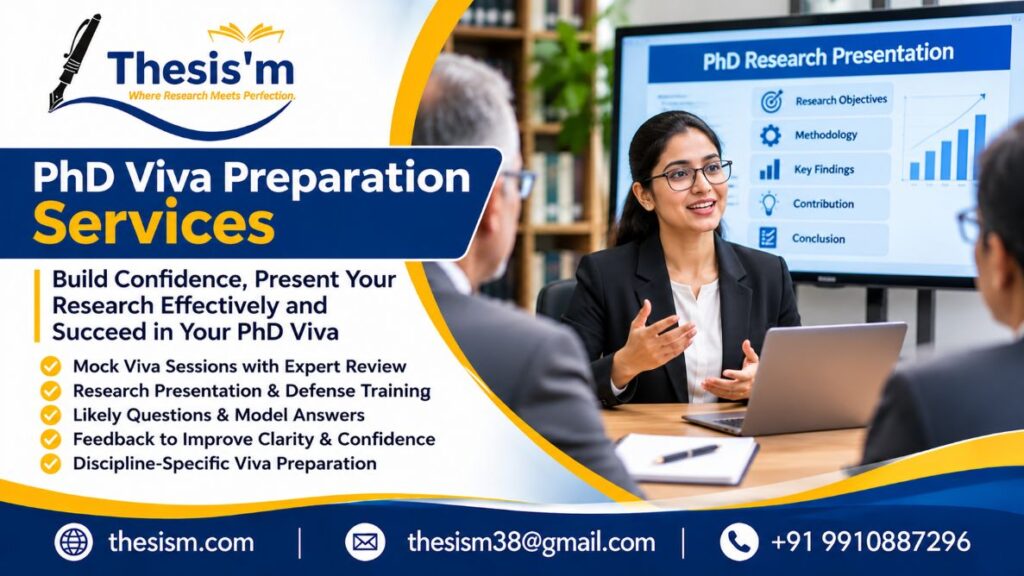
The PhD viva voce is an important stage of doctoral research. It gives research scholars an opportunity to present their work, explain their research decisions, discuss their findings and respond to questions from examiners. A successful viva requires more than knowing the contents of your thesis. You should also be able to communicate your research clearly, justify your methodology, explain your contribution and discuss the limitations of your study with confidence.

Thesis’m provides PhD viva preparation services for doctoral scholars and researchers who want structured guidance before their thesis defence. Our research consultancy focuses on understanding your thesis, preparing for possible examiner questions, strengthening your research presentation and improving your ability to explain complex academic concepts.
Whether you are preparing for an upcoming viva, have received examiner comments or want to improve your research presentation, we help you approach your defence with better preparation and clarity.
Comprehensive PhD Viva Preparation and Guidance
A doctoral viva can cover different aspects of your research, from the selection of your topic to the interpretation of your findings. Examiners may ask why you selected a particular research problem, how your methodology supports your objectives and what contribution your study makes to existing knowledge.
Thesis’m provides preparation guidance across important areas of your doctoral research:
- Understanding your thesis chapter by chapter
- Preparing a clear research presentation
- Explaining your research problem and objectives
- Justifying research methodology and design
- Discussing literature review and research gaps
- Explaining data analysis and research findings
- Presenting the original contribution of your research
- Understanding research limitations and future scope
- Practising responses to possible examiner questions
- Preparing for academic discussion and critical questions
Key Areas Covered in PhD Viva Preparation
1. Complete Thesis Understanding
Before attending a viva, you should be able to explain the central ideas and important details of your thesis without relying entirely on written notes.
Our preparation guidance helps you review:
- Research background and study context
- Research problem and its significance
- Research objectives and questions
- Literature review and theoretical framework
- Research methodology and design
- Data collection and analysis
- Major findings and interpretation
- Conclusions and recommendations
- Research contribution and limitations
This review helps you connect different chapters and understand how each section contributes to the overall research.
2. Research Presentation Preparation
Your research presentation should communicate the purpose, approach, findings and contribution of your study in a logical sequence.
We provide guidance on organising presentation content around:
- Research title and introduction
- Background and research problem
- Research objectives and hypotheses
- Literature review and identified research gap
- Research methodology
- Data analysis and key findings
- Discussion and interpretation
- Conclusion and recommendations
- Original contribution and future research scope
The presentation should follow your university’s instructions and the time allocated for the viva.
3. Research Methodology Justification
Methodology-related questions are an important part of many doctoral defences. Examiners may ask why you selected a particular research design, sampling technique, data collection method or analytical approach.
Preparation can cover:
- Selection of qualitative, quantitative or mixed-methods research
- Justification of research design
- Population and sample selection
- Sampling techniques and sample size
- Questionnaire and interview methods
- Data collection procedures
- Statistical techniques and analytical tools
- Research validity, reliability or trustworthiness, where applicable
- Ethical considerations
The objective is to help you understand the reasoning behind your research decisions and explain them clearly.
4. Data Analysis and Findings Explanation
Researchers should be prepared to explain how their data supports the conclusions of the study. Simply presenting tables, charts or statistical results may not be sufficient during an academic discussion.
We help you prepare to explain:
- Descriptive and inferential statistical results
- Hypothesis testing and interpretation
- SPSS output and statistical findings
- Tables, graphs and research figures
- Qualitative themes and findings
- Relationships between research variables
- Important patterns and observations
- Findings in relation to research objectives
Your explanations should remain consistent with the actual data and analysis presented in your thesis.
5. Research Contribution and Originality
Examiners may ask what your research adds to the existing body of knowledge and how it addresses the identified research gap.
Preparation guidance can help you explain:
- The research gap addressed by your study
- The originality of your research approach
- New insights generated through your findings
- Theoretical or conceptual contribution
- Practical implications of the research
- Relevance to your academic discipline
- Potential applications and future research directions
You should be able to explain your contribution accurately without overstating the significance of your findings.
6. Possible Examiner Questions and Answer Practice
Preparing for different types of questions can help you organise your thoughts before the actual viva. The questions will depend on your research subject, thesis content, methodology and institutional expectations.
We help researchers prepare for questions such as:
- Why did you select this research topic?
- What is the main research problem?
- What research gap does your study address?
- What are the key objectives of your research?
- Why did you choose this particular methodology?
- How did you select your sample?
- Which analytical techniques did you use and why?
- What are the most important findings?
- How do your findings relate to previous studies?
- What is the original contribution of your research?
- What are the major limitations of your study?
- What would you change if you conducted the research again?
- What future research can be undertaken in this area?
We can also help organise a subject-specific question bank based on the research material you provide.
7. Handling Critical Questions and Research Limitations
Not every viva question will be straightforward. Examiners may challenge assumptions, ask for clarification or discuss limitations in your research approach.
Preparation focuses on helping you:
- Understand the reasoning behind your research choices
- Explain limitations honestly
- Distinguish between findings and assumptions
- Respond to questions without unnecessary arguments
- Acknowledge alternative approaches
- Explain the scope of your conclusions
- Discuss possible improvements and future research
A clear, evidence-based response is generally more useful than an unsupported or overly defensive answer.
PhD Viva Presentation and Defence Support
A well-organised presentation helps examiners follow your research and understand its central contribution. Your slides should highlight the most important information rather than reproduce entire thesis chapters.
| Presentation section | Information to communicate |
|---|---|
| Introduction | Research background and context |
| Research problem | Problem statement and research need |
| Objectives | Main objectives and research questions |
| Literature review | Relevant studies and research gap |
| Methodology | Research design, sample and data collection |
| Data analysis | Analytical methods and important results |
| Findings | Key outcomes of the research |
| Discussion | Interpretation and connection with existing studies |
| Conclusion | Main conclusions and recommendations |
| Contribution | Original contribution and future research scope |
Thesis’m can provide guidance on slide structure, content selection, presentation flow and preparation for the discussion that follows.
Subject-Wise PhD Viva Preparation
Viva questions and expectations can vary considerably across academic disciplines. Preparation should reflect the research methods, terminology and subject knowledge relevant to your thesis.
| Research discipline | Important viva preparation areas |
|---|---|
| Management and Business Studies | Business models, management theories, organisational research and strategic findings |
| Commerce and Finance | Financial analysis, accounting methods, banking research and economic interpretation |
| Education | Educational theories, teaching methods, learning outcomes and research design |
| Computer Science and IT | Technical architecture, algorithms, software development and experimental results |
| Engineering and Technology | Technical methodology, design decisions, testing and performance evaluation |
| Social Sciences | Theoretical frameworks, social research methods and interpretation of findings |
| Humanities | Literature analysis, historical interpretation, conceptual arguments and source evaluation |
| Law | Legal reasoning, statutory interpretation, case analysis and research contribution |
| Medical and Life Sciences | Research protocols, study design, experimental findings and scientific interpretation |
| Environmental Studies | Environmental methods, field observations, sustainability findings and practical implications |
Preparation for Thesis Corrections and Examiner Feedback
In some doctoral programmes, researchers may receive questions, observations or correction requirements following thesis evaluation. Understanding these comments and preparing clear responses is an important part of the academic process.
Thesis’m can provide guidance with:
- Reviewing examiner observations
- Understanding comments and requested clarifications
- Organising thesis correction points
- Preparing a response-to-examiners document
- Identifying sections that may require revision
- Improving explanations of research decisions
- Checking consistency between revised chapters and original findings
Any changes to the research content should accurately reflect the underlying study and comply with university instructions.
Our PhD Viva Preparation Process
A structured preparation process helps you focus on the most important areas of your thesis before the defence.
- Understand your thesis: We review the thesis, research subject, objectives and academic requirements you share.
- Identify preparation areas: We identify important concepts, methodology decisions, findings and sections that may need additional explanation.
- Organise the presentation: We help structure the research presentation according to the university’s instructions.
- Prepare possible questions: We develop relevant practice questions based on your thesis and research discipline.
- Review answers and explanations: We help improve the clarity, relevance and academic reasoning of your responses.
- Conduct practice preparation: Where required, we support mock viva-style question-and-answer practice.
- Review final readiness: We help you check the presentation, key research arguments and important thesis details.
What You Should Share for PhD Viva Preparation
The quality of preparation depends on understanding your actual research work. Sharing relevant academic material helps make the guidance more focused.
| Information or document | How it helps |
|---|---|
| Final thesis or latest draft | Understand the complete research |
| Research title and discipline | Identify the subject-specific context |
| Abstract | Understand the overall research direction |
| Research objectives | Review the purpose of the study |
| Methodology chapter | Prepare for research design questions |
| Data analysis and findings | Understand the results and their interpretation |
| Presentation instructions | Follow university requirements |
| Existing presentation slides | Review content and presentation flow |
| Examiner comments, if available | Prepare for specific observations |
| Viva date and time allocation | Plan the preparation schedule |
You can begin with your thesis and abstract if you do not have all the supporting documents ready.
Why Choose Thesis’m for PhD Viva Preparation Services?
Preparing for a doctoral defence requires a clear understanding of your own research and the ability to communicate it effectively. Thesis’m focuses on practical academic guidance that helps scholars prepare systematically.
- Thesis-focused preparation: Guidance based on your actual research rather than generic viva questions.
- Subject-oriented support: Preparation aligned with your academic discipline and research approach.
- Methodology clarity: Help understanding and explaining research design and analytical decisions.
- Presentation guidance: Support with organising research content into a clear presentation.
- Question preparation: Practice questions based on thesis chapters and important research areas.
- Critical discussion: Guidance on explaining limitations, research choices and contributions.
- Academic communication: Focus on clear, relevant and evidence-based answers.
- Confidential handling: Responsible treatment of the research material you share.
Our aim is to help you understand and present your own research confidently. We do not guarantee viva outcomes, examiner decisions or degree awards.
Get Professional Guidance for Your PhD Thesis Defence
Your PhD viva is an opportunity to demonstrate your understanding of the research you have completed. Preparing your presentation, reviewing your methodology, understanding your findings and practising responses to possible questions can help you approach the defence in a more organised way.
If your viva is approaching, connect with Thesis’m to discuss your thesis, research discipline and preparation requirements.

📞 Contact Thesis’m – Get Support for Your PhD Viva Preparation
🌐 Website: https://thesism.com
📞 Phone: +91 9910887296
📧 Email: thesism38@gmail.com
💬 Contact Us: https://thesism.com/contact/
Frequently Asked Questions About PhD Viva Preparation Services
1. What are PhD viva preparation services?
PhD viva preparation services provide academic guidance to help doctoral scholars prepare for their thesis defence. This may include thesis review, presentation planning, possible examiner questions, methodology explanations and practice discussions.
2. How can I prepare for my PhD viva?
Start by reviewing your thesis chapter by chapter. Understand your research problem, objectives, literature review, methodology, findings, conclusions and original contribution. Practise explaining your research in clear language and prepare for questions about your research decisions.
3. Can you prepare possible questions based on my thesis?
Yes. We can help develop a subject-specific practice question bank using your thesis, research objectives, methodology, findings and other relevant academic material.
4. Do you provide mock viva preparation?
Yes. Mock viva-style preparation can be arranged to help you practise answering academic questions, explaining research decisions and discussing your findings.
5. Can you help prepare my PhD viva presentation?
Yes. We provide guidance on presentation structure, slide content, research highlights, findings and the logical flow of your thesis defence presentation.
6. Can you help me explain my research methodology during the viva?
Yes. We can help you review your research design, sampling approach, data collection methods and analytical techniques so you can explain the reasoning behind your methodological decisions.
7. Do you provide SPSS and statistical findings explanation for viva preparation?
We provide research-oriented guidance to help you understand statistical methods, SPSS outputs, hypothesis testing and findings presented in your thesis. Explanations should remain consistent with your actual analysis.
8. Can you help if I have received corrections from my examiner?
Yes. We can help you understand examiner comments, organise correction points and prepare clear academic responses based on your research and the university’s instructions.
9. When should I start preparing for my PhD viva?
It is helpful to begin preparation as soon as your thesis is submitted or your viva date is announced. Starting early gives you more time to review your research, organise presentation material and practise answering questions.
10. Does viva preparation guarantee successful thesis defence?
No. Preparation can help improve your understanding and presentation of the research, but the final outcome depends on your thesis quality, academic performance, examiner assessment and university regulations.
11. What documents should I share for viva preparation?
Your thesis, abstract, research objectives, methodology, findings and university presentation instructions are useful starting points. You can also share existing slides and examiner comments if available.
12. How can I contact Thesis’m for PhD viva preparation?
You can call +91 9910887296, email thesism38@gmail.com or submit your requirements through the contact page at https://thesism.com/contact/.
Prepare for Your PhD Viva with Thesis’m
A confident thesis defence begins with a strong understanding of your research. From reviewing thesis chapters and preparing presentation material to practising examiner questions and explaining research findings, structured preparation can help you communicate your academic work more effectively.
Contact Thesis’m to discuss your PhD viva preparation requirements and receive research-oriented guidance for your upcoming thesis defence.
🌐 Website: https://thesism.com
📞 Phone: +91 9910887296
📧 Email: thesism38@gmail.com
💬 Contact Us: https://thesism.com/contact/