
Research data provides the evidence needed to answer research questions, examine hypotheses, and establish meaningful findings. However, collecting information is only one part of a research project. The real challenge often begins when researchers need to organize datasets, select suitable analytical techniques, interpret results, and present their findings in an academically appropriate manner.
For PhD scholars and postgraduate students, data analysis is an essential component of many dissertations, theses, research papers, and academic projects. Choosing an unsuitable statistical method or interpreting results incorrectly can affect the validity and presentation of the research.
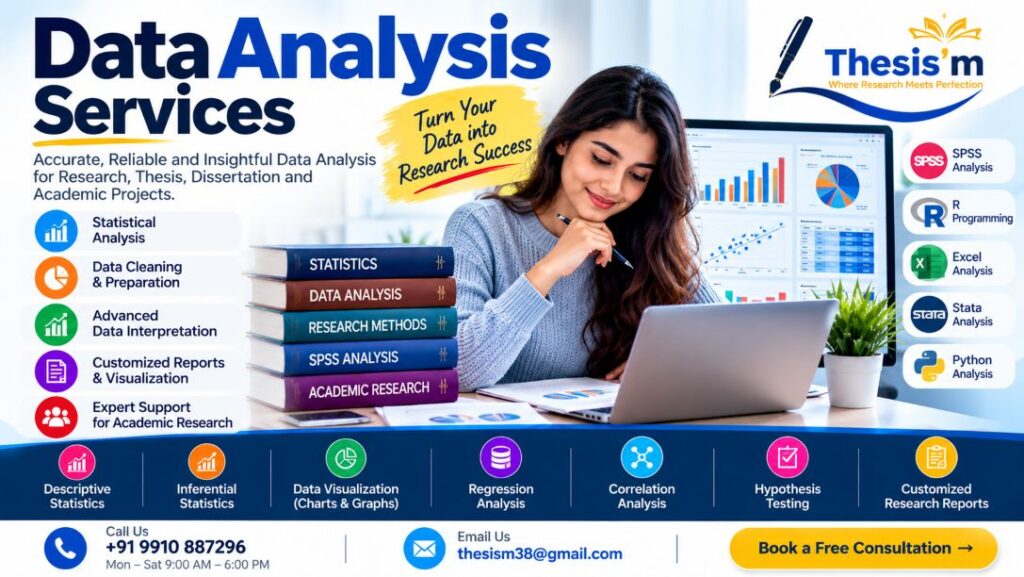
Thesis’M provides data analysis services for researchers, academicians, PhD scholars, and postgraduate students. Our research assistance covers quantitative data analysis, qualitative data analysis, SPSS analysis, statistical testing, interpretation of results, and preparation of research findings.
Whether you are working with survey responses, questionnaire data, interview transcripts, experimental observations, or secondary datasets, we provide research-oriented analytical guidance based on your study objectives and methodology.
Find the Right Analytical Approach for Your Research Data
Every research project has different analytical requirements. The appropriate method depends on the research questions, type of data, variables, sample characteristics, and selected research design.
Thesis’M supports different approaches to research data analysis so that researchers can select methods aligned with their academic objectives.
Quantitative Data Analysis Services
Quantitative research involves numerical information that can be examined using mathematical and statistical techniques. It is commonly used in management, economics, education, psychology, commerce, healthcare research, and social sciences.
Our quantitative data analysis services cover different stages of numerical data evaluation, including:
- Data organization and preparation.
- Variable identification and classification.
- Frequency and percentage analysis.
- Descriptive statistical analysis.
- Comparative analysis.
- Correlation and regression techniques.
- Hypothesis testing.
- Results interpretation and presentation.
The choice of statistical method depends on the research design, measurement scales, assumptions, and objectives of the study.
Qualitative Data Analysis Services
Qualitative research examines experiences, opinions, behaviours, observations, and other non-numerical information. It is often used when researchers want to understand complex subjects in greater depth.
Our qualitative data analysis services may include:
- Interview transcript organization.
- Coding and categorization guidance.
- Identification of recurring patterns.
- Thematic analysis.
- Content analysis.
- Interpretation of qualitative findings.
- Presentation of themes and supporting evidence.
We help researchers organize qualitative information into meaningful findings while maintaining the context of the original responses.
Mixed-Methods Research Analysis
Some academic studies combine numerical measurements with interviews, observations, or other qualitative information.
Mixed-method research requires researchers to examine both types of information and explain how their findings relate to one another.
Our research data analysis services can support the organization, evaluation, and interpretation of quantitative and qualitative findings according to the study design.
Statistical Analysis Services for Academic Research
Statistical analysis helps researchers understand patterns, relationships, differences, and trends within their datasets. Selecting the correct statistical technique is important for producing meaningful and defensible research findings.
Thesis’M provides statistical analysis services based on the nature of the research and the questions being investigated.
Descriptive Statistics
Descriptive statistics summarize the main characteristics of a dataset. They help researchers understand the distribution and general patterns of collected information.
Common techniques include:
- Mean and median.
- Mode and standard deviation.
- Frequency distributions.
- Percentages and proportions.
- Minimum and maximum values.
- Tables and graphical summaries.
These methods are frequently used in the initial examination of questionnaire responses and survey datasets.
Inferential Statistical Analysis
Inferential statistics help researchers examine relationships, differences, and potential patterns beyond the collected sample, subject to appropriate assumptions and sampling considerations.
Depending on the research requirements, analysis may include:
- Independent and paired sample t-tests.
- Analysis of variance (ANOVA).
- Chi-square tests.
- Correlation analysis.
- Linear and multiple regression.
- Non-parametric tests.
- Hypothesis testing.
The suitability of each technique must be evaluated against the study objectives, data characteristics, and statistical assumptions.
Reliability and Validity Analysis
Research questionnaires and measurement instruments may require statistical evaluation before their results are interpreted.
We provide assistance with reliability analysis and relevant validity-related evaluation, depending on the research design and measurement framework.
Regression and Relationship Analysis
Researchers often investigate whether one or more variables are associated with or help explain changes in another variable.
Our statistical analysis assistance can cover appropriate regression techniques, correlation assessment, interpretation of coefficients, and presentation of analytical results.
SPSS Data Analysis Services for Thesis and Dissertation Research
SPSS is widely used in academic research for managing datasets and conducting statistical analysis. It is particularly useful for survey-based studies, questionnaire research, and quantitative dissertations.
Thesis’M provides SPSS data analysis services for students and researchers who require assistance with statistical procedures, output interpretation, and academic presentation.
SPSS Data Preparation and Organization
Before performing statistical tests, datasets must be properly organized. This includes reviewing variables, coding responses, identifying missing values, and checking data consistency.
We provide SPSS analysis services to help researchers prepare datasets for appropriate statistical procedures.
Questionnaire and Survey Data Analysis
Survey research frequently involves responses collected through structured questionnaires. Such data may contain demographic information, rating scales, categorical responses, and multiple research variables.
Our SPSS data analysis services can support:
- Questionnaire data coding.
- Frequency and percentage tables.
- Descriptive statistics.
- Cross-tabulation.
- Reliability testing.
- Correlation analysis.
- Regression analysis.
- Hypothesis testing.
SPSS Output Interpretation
Statistical software generates numerical tables and analytical outputs, but researchers must understand what those results mean.
We assist with interpreting relevant SPSS outputs, understanding statistical significance, reviewing analytical findings, and presenting results in relation to research objectives and hypotheses.
SPSS Analysis for PhD Research
Doctoral research may involve multiple variables, complex research models, and detailed statistical requirements.
Our SPSS help for PhD research focuses on understanding the research framework, selecting suitable analytical procedures, and presenting findings clearly and accurately.
Data Analysis Support for Theses, Dissertations and Research Papers
The analytical requirements of a thesis may differ from those of a journal manuscript or postgraduate dissertation. Each document must follow its own research objectives and institutional or publication guidelines.
Thesis’M provides specialized research assistance for different academic documents.
Thesis Data Analysis Services
A thesis may require detailed analysis across multiple research objectives and hypotheses. Our thesis data analysis services support researchers with dataset evaluation, statistical techniques, results interpretation, and presentation of findings.
Dissertation Data Analysis Services
Dissertation research often involves questionnaire responses, interviews, experimental observations, or secondary information.
Our dissertation data analysis services help students understand their datasets, select appropriate analytical approaches, and organize results according to their research questions.
PhD Data Analysis Services
Doctoral research may require advanced analytical techniques and a detailed explanation of statistical findings.
We provide PhD data analysis services based on the subject area, research methodology, dataset, and analytical requirements of the study.
Research Paper Data Analysis
Research papers require a clear connection between research objectives, methodology, analytical results, and conclusions.
Our research data analysis assistance helps researchers improve the presentation and interpretation of findings for academic manuscripts and journal submissions.
Common Data Analysis Challenges Faced by Researchers
Researchers may encounter analytical difficulties even when they have collected sufficient information. These challenges can affect the accuracy and clarity of the final research document.
Selecting an Unsuitable Statistical Test
Different statistical tests serve different purposes. A method suitable for comparing two groups may not be appropriate for examining relationships among multiple variables.
The analytical technique should be selected according to the research question, data type, and underlying assumptions.
Dealing with Missing or Inconsistent Data
Incomplete questionnaire responses, duplicate entries, coding errors, and inconsistent values can affect the analytical process.
Datasets should be reviewed carefully before statistical analysis begins. Any decisions about missing data or exclusions should be methodologically justified.
Understanding Statistical Significance
Researchers sometimes confuse statistical significance with practical importance. A statistically significant result does not automatically indicate a large or meaningful real-world effect.
Results should be interpreted in the context of the research design, effect size, confidence intervals where appropriate, and study limitations.
Interpreting Software Outputs
Statistical software produces detailed tables and numerical results. Researchers must understand the relevant values and explain their meaning rather than simply copying outputs into a dissertation.
Presenting Findings Clearly
Research results should be organized using suitable tables, figures, explanations, and references to the research objectives. Clear presentation helps readers understand the analytical process and conclusions.
Research Data Analysis Across Different Academic Disciplines
Data analysis requirements vary according to the subject being investigated. The same statistical technique may not be appropriate for every research discipline or dataset.
Thesis’M provides research data analysis assistance across different academic areas, subject to the nature of the project and specialist requirements.
Management, Business and Commerce
Business research may involve consumer behaviour, employee satisfaction, organizational performance, marketing effectiveness, financial trends, and customer experience.
Education and Social Sciences
Research in these disciplines may examine student performance, teaching effectiveness, social attitudes, institutional practices, behavioural patterns, and educational outcomes.
Economics and Finance
Economic and financial research may involve statistical modelling, market trends, financial relationships, economic indicators, and comparative analysis.
Hospitality and Tourism
Hospitality research may involve customer satisfaction, service quality, hotel performance, tourism behaviour, destination management, and visitor experience.
Other Research Disciplines
We also consider research analysis requirements in other academic areas based on the study objectives, data characteristics, and availability of appropriate subject expertise.
What You Should Prepare Before Starting Data Analysis
Providing the correct research information helps establish an appropriate analytical approach. Before beginning an assignment, researchers should organize the following materials wherever applicable:
- Research title and objectives.
- Research questions and hypotheses.
- Approved research methodology.
- Questionnaire or data collection instrument.
- Raw dataset in Excel, SPSS, CSV, or another suitable format.
- Variable descriptions and coding details.
- University or supervisor instructions.
- Required statistical methods, if already specified.
- Expected format for presenting results.
If you are unsure which statistical technique is suitable, the research objectives and dataset can be reviewed before deciding on the analytical approach.
Why Researchers Choose Thesis’M for Data Analysis Assistance
Research analysis requires careful consideration of methodology, data quality, statistical procedures, and interpretation. The objective should be to produce findings that accurately reflect the collected information.
Thesis’M focuses on the following principles:
- Research-Based Approach: Analytical methods are considered according to research objectives and methodology.
- Methodological Accuracy: Attention to statistical procedures and their relevant assumptions.
- Clear Interpretation: Focus on explaining findings in understandable academic language.
- Confidentiality: Careful handling of research datasets and academic documents.
- Individual Attention: Support based on the subject, research design, and data requirements.
- Academic Integrity: No fabrication, manipulation, or misrepresentation of research findings.
- Transparent Communication: Clear discussion of the required analysis and agreed deliverables.
Our aim is to help researchers understand their data and present their findings with greater clarity and confidence.
📊 Contact Thesis’M – Professional Research Data Analysis Assistance

Need assistance with SPSS, statistical testing, questionnaire analysis, or dissertation research data? Share your requirements with our team.
🌐 Website: thesism.com
📞 Phone: +91 9910887296
📧 Email: thesism38@gmail.com
💬 Contact Us: Visit our Contact Page
Frequently Asked Questions About Data Analysis Services
1. What do data analysis services include?
Data analysis services may include dataset preparation, descriptive statistics, inferential statistics, hypothesis testing, SPSS analysis, qualitative analysis, statistical interpretation, and presentation of research findings.
2. Do you provide research data analysis services for PhD scholars?
Yes. Thesis’M provides research data analysis assistance for PhD scholars, postgraduate students, academicians, and researchers according to their research requirements.
3. Do you provide SPSS data analysis services?
Yes. We provide SPSS data analysis assistance covering data preparation, descriptive statistics, reliability analysis, correlation, regression, hypothesis testing, and output interpretation.
4. Can you analyse questionnaire and survey data?
Yes. We assist with questionnaire coding, survey data organization, frequency analysis, descriptive statistics, reliability testing, and other suitable analytical techniques.
5. What is the difference between quantitative and qualitative data analysis?
Quantitative data analysis examines numerical information using statistical methods. Qualitative data analysis examines non-numerical information such as interviews, observations, and written responses through methods such as coding and thematic analysis.
6. Do you provide statistical analysis services for dissertations?
Yes. Our statistical analysis services support dissertation research, including descriptive statistics, hypothesis testing, correlation, regression, and other appropriate techniques.
7. Can you help interpret SPSS results?
Yes. We provide assistance with understanding SPSS outputs, interpreting relevant statistical values, and presenting findings in relation to research objectives and hypotheses.
8. Do you provide data analysis services for research papers?
Yes. We assist researchers with data analysis, statistical interpretation, and results presentation for research papers and academic manuscripts.
9. Which file formats can I share for data analysis?
Depending on the assignment, researchers may share Excel, CSV, SPSS, and other suitable data formats, along with research objectives and relevant methodology details.
10. Can you guarantee a particular research outcome or statistical result?
No. Research findings must reflect the actual data and appropriate analytical methods. We do not fabricate, manipulate, or guarantee specific statistical outcomes.
11. How can I get started with Thesis’M data analysis services?
Contact our team with your research topic, objectives, methodology, dataset, and university requirements. We can discuss the appropriate analytical assistance for your project.
📈 Make Your Research Findings Clearer with Thesis’M
Good research depends not only on collecting information but also on understanding what the data reveals. Appropriate analysis helps researchers examine their questions, evaluate hypotheses, and communicate findings with greater accuracy.
Whether you are preparing a PhD thesis, completing a dissertation, analysing questionnaire responses, or working on a journal manuscript, Thesis’M can support your research analysis requirements.

Share your research details with our team to discuss suitable statistical, SPSS, quantitative, or qualitative analysis assistance.
🌐 Website: thesism.com
📞 Phone: +91 9910887296
📧 Email: thesism38@gmail.com
💬 Contact Us: Visit our Contact Page