
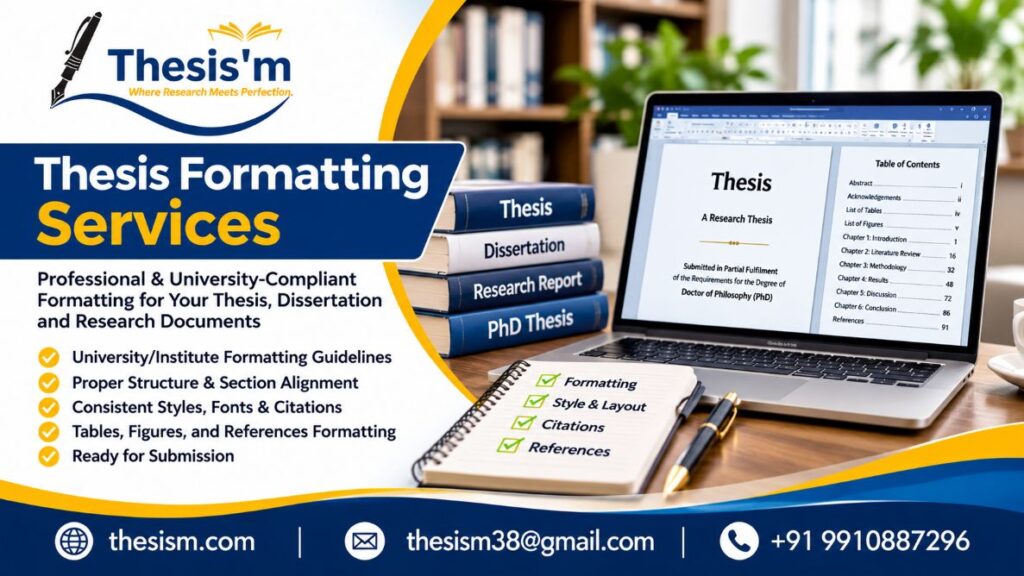
A thesis may contain extensive research, valuable findings and carefully developed academic arguments, but its presentation must also meet the formatting requirements established by the university. Incorrect margins, inconsistent headings, page-numbering problems, improperly formatted tables and reference-list inconsistencies can create unnecessary difficulties during the final submission process.
Thesis’m provides Thesis Formatting Services for PhD scholars, postgraduate students and academic researchers who need assistance organising their completed research documents according to university guidelines. Our support focuses on document layout, chapter formatting, heading hierarchy, page numbering, tables, figures, citations, references and the overall presentation of the manuscript.
Whether you are preparing your first thesis submission, revising a dissertation after supervisor feedback or arranging a final document for university evaluation, our team can help you organise the manuscript into a consistent and professionally presented academic document.
Prepare Your Thesis According to University Formatting Requirements
Universities and academic institutions may prescribe specific requirements for thesis presentation. These instructions can cover everything from the title page and preliminary sections to chapter layouts, reference formatting and appendices.
Our thesis formatting support can address:
- Page size, margins and orientation.
- Font type, font size and line spacing.
- Chapter titles and section headings.
- Heading levels and numbering.
- Page numbering and section breaks.
- Table and figure placement.
- Captions, labels and cross-references.
- Table of contents and list of figures.
- Citation and bibliography presentation.
- Appendix organisation and numbering.
- Header, footer and document layout.
- Consistency across the complete thesis.
The formatting work is based on the university guidelines or document specifications provided by the researcher.
Thesis Formatting Components We Can Help Organise
A complete thesis contains several document elements that must follow a consistent presentation pattern. Each component requires attention during the formatting process.
1. Thesis Title Page
The title page introduces the research document and generally includes the thesis title, researcher’s details, degree information, university name and submission details according to institutional instructions.
We can help organise these elements and align them with the supplied title-page template.
2. Preliminary Pages and Front Matter
The opening pages of a thesis may include several academic and administrative sections.
Depending on university requirements, formatting support can cover:
- Declaration.
- Certificate or approval page.
- Acknowledgements.
- Abstract.
- Table of contents.
- List of tables.
- List of figures.
- List of abbreviations.
- List of symbols.
The order and presentation of these sections should follow the applicable university guidelines.
3. Chapter Titles and Heading Hierarchy
A consistent heading structure helps readers navigate a lengthy academic document.
We help organise:
- Main chapter headings.
- Primary section headings.
- Secondary subsections.
- Numbered headings.
- Consistent heading fonts and spacing.
- Alignment and indentation.
4. Page Margins and Document Layout
Universities may prescribe specific margins to accommodate printing, binding and institutional archiving requirements.
Formatting can include:
- Page dimensions.
- Left, right, top and bottom margins.
- Portrait or landscape orientation.
- Paragraph alignment.
- Indentation.
- Page breaks.
- Section breaks.
- Header and footer positioning.
5. Page Numbering and Section Breaks
Thesis documents frequently use different numbering systems for preliminary pages and main chapters.
We can help organise page numbering according to the supplied requirements, including Roman numerals for preliminary sections and Arabic numerals for the main chapters where required.
6. Tables, Figures and Illustrations
Tables, graphs, charts, photographs and other illustrations should follow a consistent numbering and caption format.
Formatting support can cover:
- Table numbering.
- Figure numbering.
- Caption placement.
- Table headings.
- Figure descriptions.
- Textual cross-references.
- Alignment and spacing.
- Landscape presentation where necessary.
7. Table of Contents and Lists
A correctly organised table of contents helps readers locate chapters and sections. We can assist with setting up Word heading styles and generating or updating the table of contents, list of tables and list of figures.
8. References and Bibliography
The reference section should follow the citation style and institutional requirements specified by the researcher.
We can help format references and organise bibliographic entries according to styles such as APA, Harvard, MLA, Chicago and other specified formats. Source verification and bibliographic accuracy should be agreed separately.
9. Appendices and Supporting Documents
Appendices may contain questionnaires, supplementary tables, research instruments, supporting calculations and other additional material.
We help organise appendix headings, numbering, page breaks and document presentation according to the supplied guidelines.
Thesis Formatting Checklist for University Submission
Before submitting a thesis, researchers should review the important document requirements established by their institution.
| Formatting element | What should be checked |
|---|---|
| Page size | Required paper dimensions |
| Margins | University-prescribed page margins |
| Font | Approved font family and size |
| Line spacing | Required paragraph and line spacing |
| Paragraphs | Indentation, alignment and spacing |
| Headings | Consistent hierarchy and numbering |
| Chapters | Correct order and page breaks |
| Page numbers | Appropriate numbering format and placement |
| Table of Contents | Accurate headings and page numbers |
| Tables and Figures | Captions, numbering and placement |
| References | Required citation and bibliography style |
| Appendices | Correct labels, order and presentation |
| Final document | Consistent layout throughout the manuscript |
These are general areas to review. The actual specifications must be taken from the researcher’s university guidelines rather than assumed to be identical across institutions.
Formatting Support for Different Academic Documents
Formatting requirements can differ according to the type of research document and academic programme.
PhD Thesis Formatting
Doctoral theses may contain extensive chapters, research instruments, figures, tables and appendices. We help organise these components into a consistent document structure based on institutional requirements.
Master’s Dissertation Formatting
Postgraduate dissertations require attention to chapter organisation, preliminary pages, headings, page numbering and reference presentation.
MPhil Research Document Formatting
Researchers preparing MPhil dissertations or research documents can request formatting assistance according to their programme specifications.
Research Project Report Formatting
Academic project reports may require structured headings, tables, figures, references and supporting appendices.
Thesis Revision and Resubmission Formatting
Researchers who have revised their manuscripts after supervisor or examiner feedback may need to update headings, numbering, page references and the table of contents.
Thesis Formatting According to Different Referencing Styles
Referencing requirements are an important part of academic document presentation. Different universities, departments and journals may specify different citation and bibliography conventions.
| Referencing style | Common academic use |
|---|---|
| APA | Psychology, education and social sciences |
| Harvard | Business, management and various academic disciplines |
| MLA | Humanities and language studies |
| Chicago | History and selected humanities disciplines |
| IEEE | Engineering and technical research |
| Vancouver | Medical and health-related research |
| Other institutional styles | University-specific or departmental requirements |
The correct style should always be confirmed using the relevant institutional instructions. A referencing style alone may not determine every thesis formatting requirement.
Our Thesis Formatting Process
We follow a structured approach to understand the document requirements and prepare the manuscript accordingly.
Step 1 – Share Your Existing Thesis
Submit your thesis or dissertation in an editable Microsoft Word format wherever possible. A PDF can also be provided for an initial review.
Step 2 – Provide University Guidelines
Share the university formatting manual, approved thesis template or written instructions. This is important because institutional requirements can vary significantly.
Step 3 – Review the Document Structure
The existing document is assessed for chapter organisation, headings, numbering, page layout, tables, figures and references.
Step 4 – Apply the Agreed Formatting Requirements
The document is formatted according to the supplied guidelines, including page settings, styles, headings, numbering and supporting sections.
Step 5 – Review Document Consistency
The formatted manuscript is checked for visible layout inconsistencies, heading hierarchy, page numbering and other agreed presentation requirements.
Step 6 – Deliver the Revised Document
The formatted document is shared for your review. You can check the presentation against your university instructions and raise questions about the agreed work.
Common Thesis Formatting Problems We Help Resolve
Formatting errors often develop when researchers prepare chapters separately or combine documents created at different times.
Inconsistent Font and Spacing
Different chapters may contain different fonts, paragraph spacing or line spacing. Applying consistent document styles helps create a uniform presentation.
Incorrect Heading Numbering
Manually entered chapter and subsection numbers may become inconsistent after revisions. Structured heading styles and numbering can help maintain order.
Broken Table of Contents
Changes to chapter titles and page positions may make an existing table of contents inaccurate. An updated automatic table of contents can reduce this problem.
Page Numbering Errors
Preliminary pages and main chapters may require different numbering systems. Incorrect section breaks can cause numbering problems throughout the document.
Tables and Figures Moving Unexpectedly
Large tables and illustrations may disrupt page layout. Their placement and captions need to be reviewed against the document requirements.
Reference Formatting Inconsistencies
References may have inconsistent indentation, punctuation, capitalisation or ordering. These issues should be reviewed according to the specified referencing style.
Incorrect Appendix Organisation
Supporting material may become difficult to navigate when appendix labels, headings and numbering are inconsistent.
Thesis Formatting vs. Thesis Editing vs. Thesis Proofreading
These services address different aspects of academic document preparation.
| Service | Main focus | Suitable requirement |
|---|---|---|
| Thesis Formatting | Layout, structure, numbering, headings and presentation | When the document needs to follow university formatting rules |
| Thesis Editing | Academic language, sentence clarity and writing quality | When the manuscript needs writing improvements |
| Thesis Proofreading | Grammar, spelling, punctuation and final language checks | When the document needs a final error check |
A thesis may require one service or a combination, depending on its current condition. Formatting does not automatically include rewriting or extensive language editing unless those services are specifically agreed.
Why Choose Thesis’m for Thesis Formatting Services?
A thesis is an important academic document, and its final presentation should be handled carefully. Our approach focuses on consistency, attention to detail and alignment with the requirements shared by the researcher.
- Guideline-based formatting: Work organised according to the university instructions provided.
- Complete document attention: Review of chapters, preliminary pages and supporting sections.
- Consistent presentation: Attention to fonts, spacing, headings, numbering and layout.
- Research document understanding: Familiarity with common thesis and dissertation structures.
- Individual requirements: Formatting based on the academic programme and document specifications.
- Confidential handling: Responsible treatment of submitted research documents.
- Clear communication: Transparent discussion of the formatting scope and deliverables.
Our team includes Dr. Avipal Singh, Founder, Hospitality Educator and Academic Mentor, and Dr. Surbhi Rawal, Research Analyst and Academic Research Consultant. Their academic and research experience contributes to Thesis’m’s commitment to supporting researchers throughout their academic journey.
What to Share Before Requesting Thesis Formatting?
To ensure that the formatting follows your actual university requirements, prepare the following information:
- Your existing thesis or dissertation document.
- University and department name.
- Academic programme and research level.
- Official thesis formatting guidelines or template.
- Required referencing style.
- Approximate page count or word count.
- Any supervisor or university formatting comments.
- Expected submission deadline.
If your university provides a sample approved thesis, you can share it as a visual reference, subject to any applicable confidentiality restrictions.

📞 Contact Thesis’m – Professional Thesis Formatting Support
Preparing your thesis for university submission? Contact Thesis’m to discuss your document, formatting guidelines and academic presentation requirements.
🌐 Website: thesism.com
📞 Phone: +91 9910887296
📧 Email: thesism38@gmail.com
💬 Contact Us: Visit our Contact Page
Frequently Asked Questions About Thesis Formatting Services
1. What are thesis formatting services?
Thesis formatting services involve organising an academic document according to university or institutional presentation requirements. This can include page layout, margins, fonts, headings, numbering, tables, figures, references and appendices.
2. Who needs professional thesis formatting?
PhD scholars, postgraduate students, MPhil researchers and academic professionals preparing a thesis, dissertation or research report for submission may require formatting assistance.
3. Can you format my thesis according to university guidelines?
Yes. You can share the official formatting manual, template or written instructions so the document can be formatted according to the requirements provided.
4. Can you format a complete PhD thesis?
Yes. You can request formatting for the complete thesis, including preliminary pages, chapters, tables, figures, references and appendices, according to the agreed scope.
5. Do you provide formatting in Microsoft Word?
Yes. Microsoft Word is suitable for most thesis formatting requirements, including page layout, styles, automatic numbering and tables of contents. The final file format can be discussed according to your submission requirements.
6. Can you create an automatic table of contents?
Yes. We can help organise heading styles and generate or update an automatic table of contents, subject to the structure of the document.
7. Can you format references in APA or Harvard style?
Yes. We can help organise references according to APA, Harvard, MLA, Chicago, IEEE, Vancouver or another specified style.
8. Can you format tables, figures and appendices?
Yes. Formatting support can include numbering, captions, alignment, placement, headings and consistency for tables, figures and appendices.
9. Do you follow different university formatting requirements?
Yes. Formatting is based on the specific guidelines supplied by the researcher. Requirements should be checked individually rather than applying one universal template.
10. Will thesis formatting change my research content?
No. Formatting focuses on the presentation and organisation of the document. Changes to research content, arguments or findings are not part of formatting unless separately discussed.
11. Can you correct formatting after supervisor feedback?
Yes. You can share the revised thesis and supervisor comments so the required layout and presentation changes can be discussed.
12. How can I request a thesis formatting quotation?
Share your document, university guidelines, approximate page count, referencing style and deadline. Our team can review the requirements and discuss the appropriate scope and quotation.
📞 Contact Thesis’m – Get Your Thesis Ready for Submission
A properly organised thesis makes your academic work easier to navigate and present. Connect with Thesis’m to discuss formatting support according to your university’s requirements.
🌐 Website: thesism.com
📞 Phone: +91 9910887296
📧 Email: thesism38@gmail.com
💬 Contact Us: Visit our Contact Page
Thesis’m – Empowering Research. Enabling Academic Excellence.