 Thesis Writing
Reducing Similarity Without Compromising Research Quality
Originality is the foundation of credible academic research. Whether you are writing a thesis, dissertation, journal article, or research proposal, maintaining academic integrity is essential.
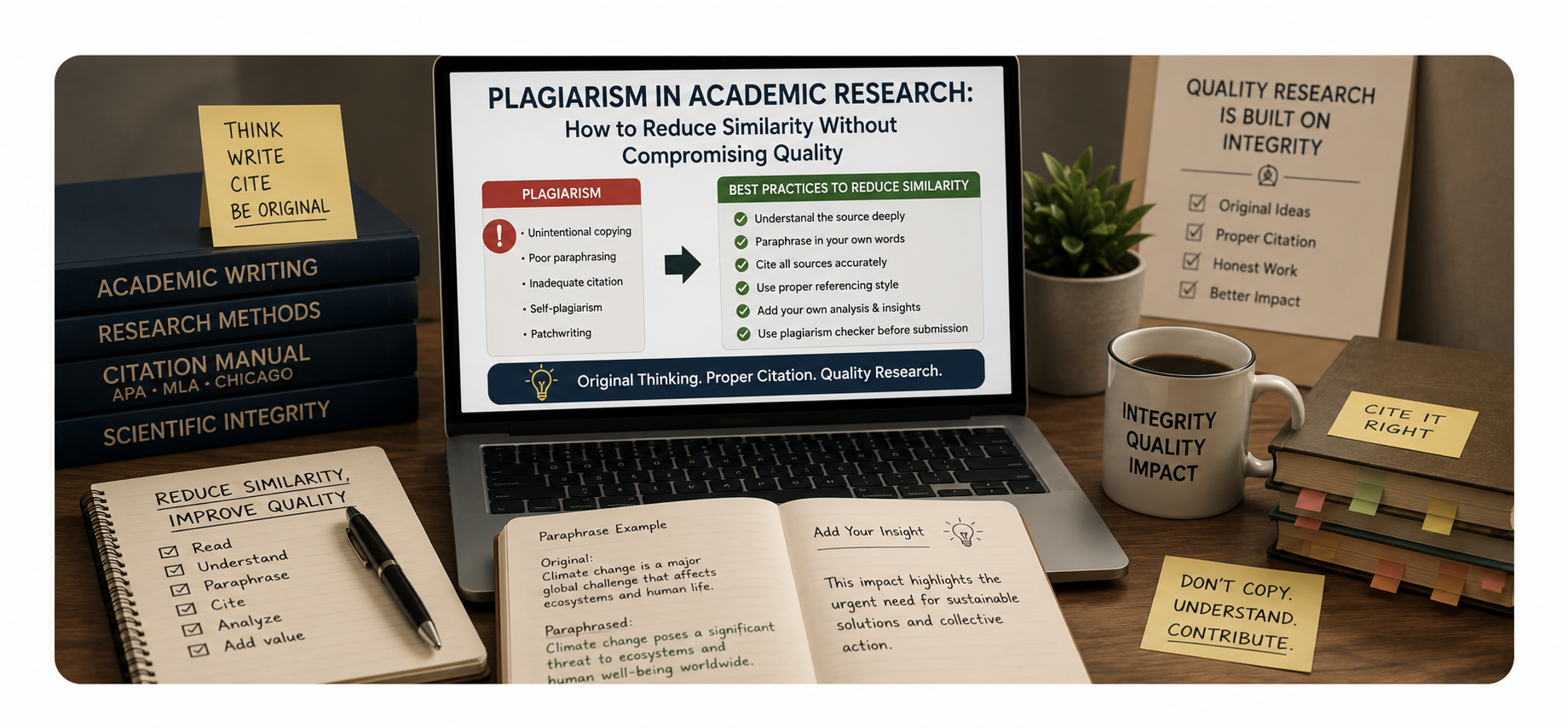
Many researchers assume that reducing plagiarism simply means replacing words with synonyms. However, genuine originality requires understanding the source material, explaining ideas independently, citing references correctly, and contributing your own academic analysis.
Why Do Similarity Scores Matter?
Similarity reports compare your document with published articles, books, websites, student papers, and academic databases. Matching content may result from copied text, weak paraphrasing, missing citations, common academic phrases, or correctly referenced quotations.
A high similarity score does not automatically prove plagiarism, and a low score does not always guarantee originality. Researchers should review individual matches carefully and determine whether each source has been quoted, paraphrased, and referenced appropriately.
Steps to Reduce Similarity Effectively
Write in your own words
Read the original source carefully, set it aside, and explain the concept based on your own understanding. Avoid replacing individual words while keeping the original sentence structure unchanged.
Cite every source properly
Include a citation whenever you use another author’s ideas, theories, statistics, arguments, findings, models, or research data.
Use quotations sparingly
Use direct quotations only when the author’s exact wording is necessary. Paraphrase or summarize information whenever the original wording is not essential.
Develop original analysis
Evaluate the strengths, limitations, research gaps, practical implications, and relevance of previous studies instead of only describing their findings.
Use multiple credible sources
Compare evidence from several reliable academic publications rather than relying heavily on one author or source throughout an entire section.
Review your references carefully
Ensure that every in-text citation appears in the reference list and that all references follow the required academic style consistently.
Check your work before submission
Review citations, quotations, paraphrased sections, figures, tables, datasets, and references before completing a final similarity check.
Common Plagiarism Mistakes and How to Avoid Them
Copying Definitions Directly
Definitions are often copied word for word from books or academic articles. Explain the concept in your own language and cite the original source.
Paraphrasing Too Closely
Changing only a few words while preserving the original sentence structure is not effective paraphrasing. Rewrite both the language and structure based on your understanding.
Missing In-Text Citations
Borrowed ideas require citations even when they have been completely rewritten. Add a reference whenever information originates from another author.
Using Templates Without Modification
Standard templates may contain repeated wording that increases similarity. Adapt the content and structure to suit your specific research project.
Reusing Previous Academic Work
Submitting sections from an earlier assignment, thesis, or publication without disclosure may be considered self-plagiarism. Acknowledge previous work whenever required.
Forgetting to Credit Figures and Tables
Charts, tables, figures, images, and datasets require attribution even when they have been modified, redesigned, or adapted.
Relying Heavily on One Source
Using one source throughout a chapter can make the writing appear repetitive or derivative. Compare different academic perspectives and build a balanced discussion.
Overusing Direct Quotations
Excessive quotations can increase similarity and weaken your academic voice. Use quoted material selectively and support it with your own interpretation.
Questions to Ask Before Submitting Your Research
Review these essential questions before submitting your thesis, dissertation, journal article, or research proposal.
Have I cited every borrowed idea?
Confirm that every theory, argument, statistic, finding, model, or interpretation taken from another source includes an appropriate citation.
Are my paraphrased sections genuinely original?
Check whether you have changed both the wording and sentence structure while accurately preserving the meaning of the original source.
Have I used direct quotations only when necessary?
Ensure that quotations are limited to cases where the author’s exact wording is important and that each quotation includes the required citation.
Does every citation appear in my reference list?
Compare your in-text citations with the bibliography and correct any missing, incomplete, or inconsistently formatted references.
Have I credited all figures, tables, and datasets?
Confirm that all visual materials, research data, images, and adapted content include appropriate source information.
Does my research contain enough original analysis?
Review whether your manuscript includes your own evaluation, interpretation, critical discussion, and connection to the research objectives.
Have I reviewed the similarity report carefully?
Examine every significant match, correct missing citations, improve weak paraphrasing, and verify that borrowed material has been used responsibly.
Conclusion
Reducing similarity is not about manipulating a plagiarism report. It is about producing ethical, well-researched, and genuinely original academic work.
Common problems such as copying definitions, paraphrasing too closely, missing citations, reusing previous work, and relying excessively on one source can affect academic integrity and research credibility.
By understanding your sources, writing independently, referencing evidence correctly, and contributing original analysis, you can produce high-quality research that demonstrates both scholarly excellence and academic responsibility.
“Original research requires independent thinking, accurate referencing, responsible source use, and meaningful critical analysis.”
Need Help Improving Your Research?
Thesis’m supports Master’s and PhD researchers with academic editing, proofreading, plagiarism review, referencing, research methodology, and publication assistance.
Our goal is to help you identify originality concerns, strengthen your academic writing, and submit clear, credible, and academically sound research.