 Academic Publishing
Publishing in a Scopus-Indexed Journal
Publishing a research paper in a Scopus-indexed journal is an important milestone for Master’s students, PhD scholars, researchers, and academicians. A reputable publication can strengthen your academic profile, improve research visibility, and support future opportunities in education, funding, employment, and collaboration.
For first-time authors, however, the publication process can appear complicated. Journal selection, manuscript preparation, ethical requirements, submission procedures, and peer-review revisions all require careful planning.
What Is a Scopus-Indexed Journal?
Scopus is a major abstract and citation database covering peer-reviewed academic literature. Journals included in Scopus are reviewed according to factors such as editorial quality, publishing standards, research relevance, and academic impact.
Publishing in a Scopus-indexed journal can make your research more discoverable to universities, researchers, institutions, and funding organisations worldwide. However, authors should always verify a journal’s current indexing status before submitting a manuscript.
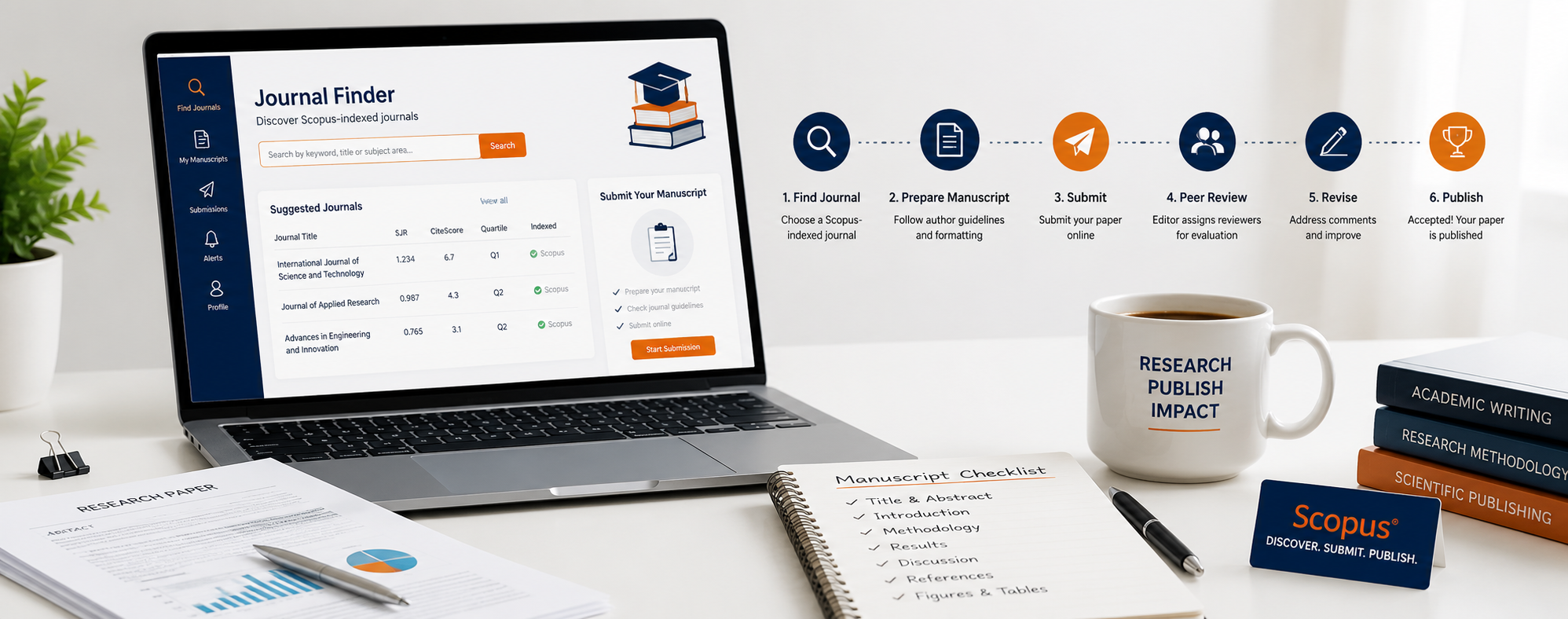
Steps to Publish Your Research Pape
Conduct high-quality research
Begin with a relevant research problem, a clearly identified research gap, an appropriate methodology, reliable data, and meaningful conclusions. Strong originality and practical or academic significance can improve your publication prospects.
Select the right journal
Choose a journal that closely matches your research topic, methodology, audience, and academic discipline. Submitting to a journal outside your subject area may lead to immediate editorial rejection.
Verify the journal’s Scopus status
Confirm that the journal is currently indexed in Scopus rather than relying only on claims published on the journal’s website. Also review its subject coverage, publisher, publication history, and indexing details.
Review the journal requirements
Check the journal’s aims and scope, quartile ranking, publication schedule, article types, word limits, referencing style, author instructions, and submission policies before preparing the final manuscript.
Prepare your manuscript
Structure the paper according to the journal’s requirements. A research article commonly includes a title, abstract, keywords, introduction, literature review, methodology, results, discussion, conclusion, and references.
Maintain academic integrity
Cite all sources accurately, avoid plagiarism and duplicate submission, reference figures and tables correctly, disclose conflicts of interest, and obtain ethical approval where required.
Submit and respond to peer review
Upload the manuscript, cover letter, author information, declarations, and supporting documents through the journal’s submission system. Respond to reviewer comments professionally, clearly, and point by point.
Common Reasons for Rejection and How to Avoid Them
Weak research objectives
Unclear objectives make it difficult for editors and reviewers to understand the purpose of the study. Define a focused research problem and ensure every section supports it.
Poor literature review
A limited or outdated literature review may fail to establish the research gap. Use credible, relevant, and recent academic sources to position your study properly.
Inappropriate methodology
A methodology that does not answer the research question can weaken the entire paper. Clearly justify your research design, sample, data collection, and analytical methods.
Lack of originality
Journals expect the study to offer a meaningful contribution. Explain clearly how your research extends, tests, applies, or challenges existing knowledge.
Failure to follow journal guidelines
Incorrect formatting, referencing, structure, or word count may result in rejection before peer review. Follow the author guidelines carefully and consistently.
Poor academic writing
Unclear language, weak organisation, grammatical errors, and unsupported claims can reduce the credibility of the manuscript. Proofread thoroughly and seek academic feedback before submission.
High plagiarism similarity
Improper paraphrasing, missing citations, or copied material may lead to rejection. Review the manuscript carefully and ensure that every borrowed idea is acknowledged correctly.
Questions to Ask Before Submitting Your Paper
Review these essential questions before submitting your manuscript to a Scopus-indexed journal.
Is the journal currently indexed in Scopus?
Verify the journal through an official and reliable source because indexing status can change over time.
Does the journal match my research area?
Review the journal’s aims, scope, recently published articles, and intended readership before submitting.
Does my study address a clear research gap?
Explain what is missing from existing research and how your paper contributes new knowledge, evidence, or application.
Have I followed all author guidelines?
Check the required structure, word count, reference style, figures, tables, declarations, and file formats.
Is the manuscript academically and ethically sound?
Confirm that citations are accurate, plagiarism has been avoided, ethical approval is documented, and conflicts of interest are disclosed.
Are my findings clearly presented?
Ensure that the results are accurate, logically organized, supported by evidence, and connected to the research objectives.
Has my manuscript been reviewed before submission?
Ask your supervisor, co-author, or academic consultant to review the paper’s argument, methodology, clarity, formatting, and journal suitability.
Conclusion
Publishing in a Scopus-indexed journal requires high-quality research, careful journal selection, accurate manuscript preparation, and strict compliance with academic and ethical standards.
Authors should verify the journal’s indexing status, follow its submission guidelines, and respond professionally to editorial and reviewer feedback. Revision requests are a normal part of publishing and can help strengthen the final paper.
With patience, preparation, and attention to detail, first-time researchers can improve their chances of successfully navigating the publication process.
“A successful publication begins with strong research, the right journal, and careful attention to every submission requirement.”
Need Help Publishing Your Research Paper?
Thesis’m supports researchers with journal selection, manuscript preparation, academic editing, proofreading, plagiarism review, submission guidance, and responses to reviewer comments.
Get Publication Support